“EUROPEAN ALLIES.
Help’, Said Trump In Iran. Why US’ European Allies Hesitated, Walked Away
47 days into the war, Europe has rejected Trump’s attacks on Iran on the back of $25B Hormuz blockade shock that spiked inflation to 2.5% and prompted 59% of EU voters to call the strikes illegal (71% Spain), while Trump’s Pope spat draws ire from Italy.
47 DAYS INTO WAR EU ALLIES HESITATE.
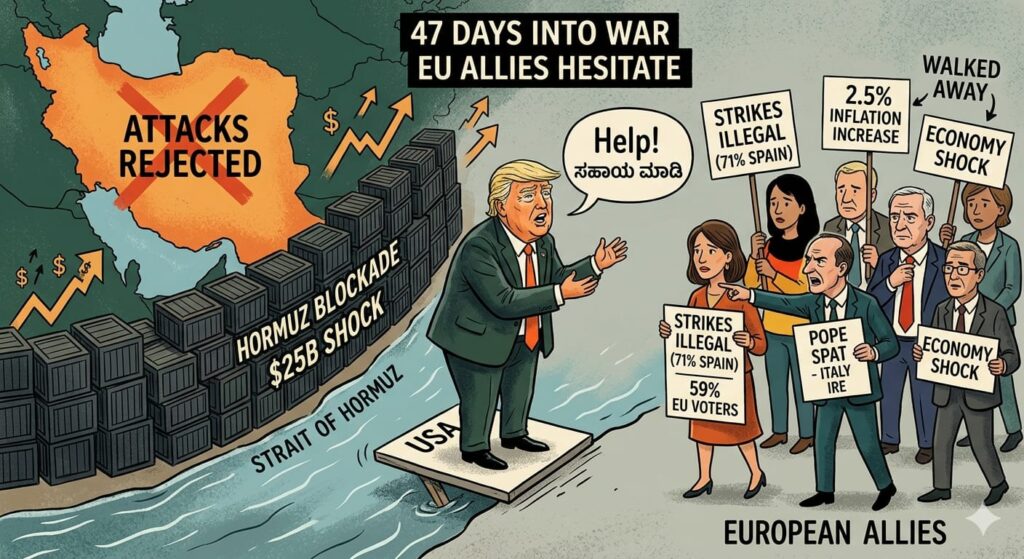
ATTACK REJECTED
“STRATAJIC AUTONOMY
While the Trump administration has ramped up its military campaign and verbal broadsides against Tehran, a unified and increasingly defiant Europe has officially rejected the American president’s approach. This shift marks the end of an era of “appeasement” and the beginning of a “Strategic Autonomy” that European leaders have long discussed but rarely practiced—until now.
The Boiling Point: Day 47
The conflict, which began in late February 2026 with a series of coordinated U.S.-Israeli strikes on Iranian nuclear and military infrastructure, has entered a grinding phase. While President Trump has recently signaled that the war is “very close to over,” the reality on the ground—and at sea—is far more volatile.
A U.S. naval blockade currently chokes the Strait of Hormuz, while Iran has countered by threatening to shut down trade through the Red Sea and the Sea of Oman. For Europe, this isn’t just a distant skirmish; it is an economic and humanitarian catastrophe. With inflation climbing and growth forecasts slashed across the Eurozone, the “Old Continent” has decided it can no longer afford to be a silent partner in Washington’s “war of choice.”
A Continent Divided No More
For the first year of the second Trump administration, European leaders were often seen as scrambling to react to unilateral American decisions. However, the Iran war has served as a catalyst for a more hardened European stance.
The New “No” from the Big Three
- France: President Emmanuel Macron has been the most vocal critic, describing the military action as a violation of international law. Paris has gone a step further, deploying the Charles de Gaulle aircraft carrier to the region not to join the U.S. strikes, but to protect independent French interests and signal that Europe will not be dragged into an escalatory spiral.
- Germany: While Chancellor Friedrich Merz initially showed sympathy for the goal of neutralizing Iran’s nuclear threat, the sheer scale of the disruption has shifted Berlin’s tone. Germany has joined the calls for an immediate and permanent ceasefire, emphasizing that “now is the time for diplomacy, not lectures.”
- United Kingdom: Prime Minister Keir Starmer has found himself in a delicate balancing act. While reaffirming the UK’s commitment to regional security, London notably restricted the use of the Diego Garcia military base for offensive strikes early in the conflict. This subtle “veto” sent shockwaves through the Pentagon.
“This is not our war,” has become the unofficial mantra in Brussels, reflecting a refusal to be implicated in a conflict that European diplomats claim was started without their consultation.
The Strategic Shift: Denying Airspace and Bases
The most significant rejection of Trump’s strategy has been operational. In a move that would have been unthinkable years ago, several Southern European nations, led by Spain, have refused to allow U.S. forces to use their bases or airspace for missions against Iran.
When President Trump threatened an embargo on Spain in response, the European Union did not buckle. Instead, it showed “unconditional solidarity,” with neighboring countries making it clear that an attack on one member’s economic interests would be treated as an attack on all. This “Greenland Lesson”—the idea that unity is the only leverage Europe has against an erratic Washington—is now being applied in full force.
The Economic Toll and the “Sovereignty” Push
The war has forced Europe to accelerate its pursuit of economic sovereignty. The 47-day conflict has caused:
- Energy Insecurity: With 20% of global oil flowing through the Strait of Hormuz, the blockade has sent energy prices soaring, threatening to tip Europe into a recession.
- The €90 Billion Defense Shift: In late 2025, anticipating American volatility, the EU agreed to a massive loan package to sustain Ukraine. The Iran war has validated this “go-it-alone” strategy, as Europe realizes it must be able to defend its own interests without relying on the U.S. security umbrella.
The Rise of New Mediators
As Europe distances itself from the Trump administration’s “maximum pressure” tactics, it has welcomed mediation from unexpected quarters. The EU leadership recently praised Pakistan for its role in brokering a fragile two-week ceasefire that began earlier this month.
By backing Pakistani and Omani mediation efforts, Europe is effectively bypassing the White House to find a “Day After” solution. The goal is no longer just a pause in fighting, but a structured return to the negotiating table—one where the U.S. is a participant, rather than the sole director.
Conclusion: A New Atlantic Reality
Forty-seven days into the war, the transatlantic relationship has been fundamentally altered. The Trump administration’s attacks on Iran, framed as a “necessary defense,” have been met with a European “rejection” that is as much about the future of the West as it is about the Middle East.
Europe is no longer willing to be the “extra” in an American-led drama. By refusing base access, withholding operational support, and seeking independent diplomatic channels, the EU has sent a clear message: the era of automatic European alignment with U.S. military adventures is over. Whether this leads to a more balanced alliance or a permanent divorce remains the defining question of 2026.
.



0 Comments